Monday, 28 September 2015

Research: Channels

MUSIC CHANNELS


Not long ago, there were only 2 TV channels. Then came another, and many more until the present day which consists of hundreds of channels. A selection of these are music channels, to offer audiences of artists the chance to see their work.

Some of these channels were created as synergies with radio stations. Advantages of this include:
  • A larger audience (traditional & modern)
  • Choice of format
  • Hype and awe over the technology of a visual platform 

_________________________________________________________________________


Certain channels have evolved according to shifts in technology and society as a whole. Music videos are no longer as entertaining as they used to be, so other forms of entertainment have been devised for consumption so viewers continue to watch TV. MTV is an example, which once featured purely music videos, but have now drifted away from videos. Instead, they cater to different interests that have expanded, such as reality TV shows (e.g. Awkward). The responsibility of satisfying music audiences has been shifted onto MTV's sister channels. These are branches of the traditional channel, MTV.


  • MTV HITS
Genres: Pop, Dance
Audience: young children/teens (6-13)
Key artists: Katy Perry, One Direction


  • MTV BASE
Genres: Hip-Hop, Rap, Urban
Audience: ethnic minorities (18-15)
Key artists: Rihanna, Chris Brown


  • MTV ROCKS
Genres: Rock, Metal, Screamo
Audience: older white males (26-35)
Key artists: Panic! At The Disco, Bring Me The Horizon


  • MTV DANCE
Genres: House, Electronic, EDM
Audience: young adults (18-25)
Key artists: David Guetta, Diplo

_________________________________________________________________________


Other music channels include: Kiss, Heart, Kerrang, Flava, Capital, Viva, 4Music, Bliss, Clubland, BOX, etc. To access most the full package of music channels, a full subscription to Sky or Virgin TV is required. This is more expensive than other packages, such as NowTV, that include less. 


_________________________________________________________________________

UNREPRESENTATIVE?

It can be argued that there are a wider range of niche genres than mainstream genres. With music channels being dominated by mainstream music, there is a double imbalance, leading to niche genres being unrepresented. If a channel were to be established for a niche genre, it would most likely only air music beyond the watershed. This is because a lot of alternative music has controversial concepts that may offend or confuse young audiences. For example, Pop is highly mainstream, whereas Grunge lost recognition after the 90's. 


_________________________________________________________________________

ADVANTAGES OF MUSIC VIDEO CHANNELS


  • more promotion
  • audience satisfaction
  • offering variety e.g. entertainment for other interests
  • sweeping; all videos blocked together for easy access
  • back-up platforms for industries
  • open doors to negotiation with other channels

DISADVANTAGES OF MUSIC CHANNELS


  • mainstream genre dominance; doesn't cater to all interests
  • loss of interest in the present day
  • can be a waste of money if it's unsuccessful 
  • literal audiences may not be target audience

_________________________________________________________________________

CONCLUSION
I plan to include controversial and enigmatic elements in my music video. So it's unlikely to air on mainstream channels such as Kiss. I'm not sure what it would air on, so a whole new channel may have to be created for videos like mine.

Thursday, 24 September 2015

Research: Institutions

MEDIA INSTITUTIONS IDENTIFICATION

Most artists are signed to a record label, which is the foundations of their contract. The contract includes information such as how many albums they have to release. Often, record label owners receive a fraction of profit generated by the artist. Record labels are branched off media institutions; conglomerates. These are companies who help produce and fund music videos for their signed artists. These institutions work in trade outside of the music industry too, like internet. 
_________________________________________________________________________

The benefits of working with a leading institution include:

  • Help (financial, promotional, etc)
  • Recognition
  • Diffusing of established audiences
  • Scope for collaborations with big artists
  • Reaching a global scale to be globally renowned
e.g. Michael Jackson as the 'King Of Pop'
_________________________________________________________________________
EMI

EMI, founded March 1931, is one of the worlds leading music companies. They own international institutions, such as Virgin - and their own record labels, like Angel, Blue Note and Capitol. Most artists funded by EMI are very niche and unheard of by the general public, such as:

Though EMI have many famous artists, like: 


  • Mariah Carey
  • Katy Perry
  • Rod Hot Chili Peppers
  • Omarion
  • Radiohead
  • Snoop Dogg
  • Spice Girls
  • Kylie Minogue


_________________________________________________________________________

Sony


Sony changed its name in 2008 from Sony BMG Music Entertainment to Sony Music Entertainment. They own record labels that cater to mainstream, international superstars. Like EMI, they offer a diversity of genres such as punk, R&B and pop.  Record labels include Arista Records, Colombia Records and J Records.

Famous artists within Sony:
  • Avril Lavigne
  • Britney Spears    
  • Beyonce
  • One Direction
  • Pitbull

_________________________________________________________________________


UMG


Being the worlds largest music content company, UMG are able to find and develop niche artists while maintaining their global success. They market and promote undiscovered music over a wide range of platforms to bring more success to 'alternative' genres.

Famous artists within UMG include:
  • Akon
  • Busta Rhymes
  • Nicki Minaj
  • Justin Bieber
  • Cheryl Cole
  • Adele
                             

_________________________________________________________________________


Warner

This institution does not reach the same global scale as the others, despite being internationally successful. Warner helps artists to achieve long-term creative and financial success by satisfying customers in the best ways possible. Unlike Sony, Warner keep artists for a long time which stabilizes their place in the small circle of success. Record labels include Atlantic, Asylum, Elektra and Warner Bros

Their artists feature:                                              
  • T.I.
  • Bruno Mars
  • Paramore
  • B.O.B

_________________________________________________________________________
DISADVANTAGES OF BEING SIGNED TO A RECORD LABEL:
  • If an artist stops selling for a while they could lose their contract
  • The contract may tell them to do things that aren't their style or interests
  • Most of the profits from album sales goes to the record label
  • This is why artists tour and converge

_________________________________________________________________________

I value raw talent more than reputation of the untalented. Generally speaking, mainstream music (particularly pop) owes it's massive audience to attractive faces and simple, catchy tunes. Therefore, if I had to pick which institution to sign with, I would pick Warner. They are known to build up the profiles of new styles of music, therefore bringing forth both talent and popularity. 

Sunday, 20 September 2015

Research: Genres

GENRE
  
A genre is literature, art or any other entertainment, that falls under a certain category based on its characteristics. Within the music industry, genre refers to the style of music. 
Different types of music are produced that depend on different factors - such as who the artist is and who their audience is. Videos that share elements are likely to fall under the same genre. 
Some traditional genres are pop (popular culture), rock and rap. Though, there are hundreds of sub-genres that also reach a wide audience, while some stay on a smaller scale. 
It is often hard to define music for what genre it is, as the diversity of music has tremendously grown over time. For example, the metal genre can be confused with death metal, screamo or noise music.
Genres continue to expand because so do audiences. Fresh interpretations and perspectives are being born into each era, so artists need to alter their style - or entirely new artists need to come forth - to keep audiences interested and satisfied. To simply put it, people have different tastes. If there were only two genres, most of the world wouldn't buy the products that come out of it. 
Without audience demand, there is no point for artists, of any genre, to continue making music as it wouldn't sell. 
__________________________________________________________________________
THE DIVERSITY OF GENRES
Not every genre is included on this list. Generally speaking, nobody necessarily knows every genre out there. This includes besides the Western world. Some genres have very distinct differences, such as House from Trap, while others are defined separately by small factors such as the tempo of sound, like R&B from Hip-Hop.
__________________________________________________________________________
 GENRE CHARACTERISITICS

 Here I have selected a few out of many genres. My selection was based on how different they are from each other, to fully emphasize the diversity. For each genre an audience, mise en scene, set of characters, theme(s) and structure have been briefly mentioned. Although these are just generalisations, and can be critically viewed as stereotypical. Alternatively, genres that do consist of dominantly white or black folk (as an example) may portray to other audiences a certain image about that ethnic group. 
_________________________________________________________________________

MAINSTREAM GENRES

Mainstream genres are types of music that are appreciated over a vast range of people. This music tends to be on the charts and playing on popular radio stations. Big budgets and star cameo appearances can aid an artist into becoming mainstream. These genres include:


  • Pop - a product of popular culture (target audience: young teens 13-15)
  • House - consisting of club and party hits (target audience: young adults 18-25)

Pop artists shown here include Katy Perry, Miley Cyrus, Justin Bieber, Taylor Swift & Robin Thicke
This analysis shows that the dominant genre is Pop, which is evidence of its' mainstream qualities compared to that of more niche genres such as Indie which had one of the smallest fractions in the pie chart.

____________________________________________________________________________________________

Though before an artist is mainstream, they're niche - sometimes always stay niche. This is most likely because they make music within a niche genre. Many sub-genres are niche, for example there is more awareness for pop than for synth-pop. Niche genres recieve smaller budgets and smaller (but more loyal) fanbases. Because the ideas aren't popular, they're often regarded as alternative. 
Niche artists indeed work to express original ideas that unfortunately do not always fit into the charts. Recently, some niche artists have gained fame, such as Grimes (formerly known as Claire Boucher). Which suggests that the diversity of genres is beginning to be more widely appreciated by the general public.
__________________________________________________________________________

AUDIENCE
The audience are a fundamental part to the success of an artist, no matter if they work under mainstream or niche genres. Profit is sourced from the audience, so artists need to have strong communication with their fans.
This is easier within niche genres. Being such a specific style, its followers will be easy to reach out to with products such as specialised merchandise and posters. However, mainstream artists have millions of different people to please, so it may be hard deciding how to do so. 
Fortunately, mainstream music earns a larger profit than niche music; therefore the stars can afford within their budget to experiment on promotion and marketing. Niche artists don't have as much flexibility, so need to choose carefully and ensure it conveys the genre with clarity. For example, a screamo t-shirt would most likely have a skull image on it. 

Beneficial to mainstream artists is their general audience, making it safe to lose fans if they change their style. Whereas a niche artist can't risk losing fans as they intially have less and a change of style would be too dramatic.  
It is important for the audience to easily indentify with the genre, so they can clarify whether it's their taste or not. If an artist has confusing platforms of promotion, a potential fan may lose interest. This is less important with mainstream artists because of their flexibility - people usually like their music regardless of the genre, as the star image generally recieves more attention. 
_________________________________________________________________________ 

 MUSIC VIDEO: Evanescense - 'Bring Me To Life'
 This falls under the Rock genre. The visuals are rather dark, e.g. lighting, which links with the somewhat melonchalic lyrics. The main character has black hair and pale skin; an appearance stereotypically associated with the rock genres. Critically, her mise en scene is bleak - the pale skin, the dreary colours, which all illustrates the rock genre. On a whole, the video is performance-based; made clear during shots of the band playing instruments. It may be narrative, as at a point she falls which could amplify "call my name and save me from the dark", although it dosn't end clearly so fits into concept too. 
__________________________________________________________________________ 

MUSIC VIDEO: Grimes - 'Realiti'
 This falls under the experimental electronic genre. The visuals reflect this as the video was shot in Japan, known for quirky and alternative ideas. Grimes' mise en scene is also assocated with the Japanese; her unusual hair colours and outfits. Her body language consists of 'weird' dance moves, amplifying the experimental side of electronic music. The editing is unpredictable, possibly unorganised which is further amplification of the 'alternative' aspects of music. On a whole, the video is concept-based as no story takes place, the audience are taken on an adventure around the streets of Japan. 
 _________________________________________________________________________

 I have learned that genre determines more than what I once thought. The genre is the base of how music is produced and promoted. Through the genre, audiences can feel connected with artists. Associated with genre are particular themes which are demonstrated through music videos. Though artists are not always independent in their work - collaborations between artists allow different genres to fuse. This allows fan bases to interact with each other, and artists to share those within their own fan base. Upon this research I am still confident in creating something unique, such as embedding controversial aspects. Sometimes music videos work in reverse psychology; audiences know they don't like it but still give it views because dislike does not interfere with interest.

I would like to create a music video for a niche genre, such as alternative R&B. However, this genre is on the rise, so can be considered in-between the niche and mainstream sectors. I want to work with a genre such as this one because, conventions around alternative sound are more blurred than that of mainstream genres; this allows for more creativity and original concepts.

Therefore the genre characteristics I want to use will be non-conventional; for example, I hope to include concept narrative with some cartoon frames or animation.
 

Research: Goodwin's Theory

GOODWIN'S THEORY OF MUSIC VIDEOS

Media theorist Goodwin came up with the general principle that most music videos do eight key things.
_________________________________________________________________________
1. Genre characteristics
Goodwin argues that depending on the genre, videos undertake particular characteristics to reflect the conventions of that genre.

POP is typically very cliche. The music and video goes hand in hand; with a focus on happy endings. This makes them mainstream too. 
Pop videos are usually performance-based by young, attractive people. Their mise en scene consists of whatever is in 'style'. Thus there is less focus on the raw musical talents of individuals. 
As pop is short for 'popular culture', it has a massive audience, resulting in the means available to enhance their production, e.g. the use of green screens. 


Katy Perry - 'California Girls'

SWING (smilar to jazz) is often shot in black and white. This is to convey a calm, serene atmosphere to match the slow, lazy pace of music. 
Swing videos have a concept style; there is no beginning middle and end but rather a continuous vibe of happiness and relaxation. 
People in the videos look very formal - e.g. women in long dresses and small heels, men in suits. Champagne, associated with mature bars, are enjoyed. The wider focus is on how the genre as a whole makes you feel.


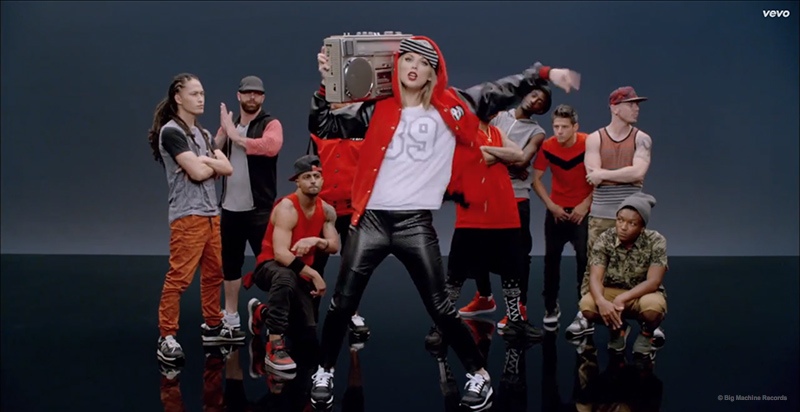
DANCE videos as expected have a dancey feel to it. Controversial aspects may be shown, like sexually suggestive dance moves and drug use. 
Though often concept-based with pure movement and mixtures of high and low key lighting, more recent dance tracks have been complimented by narrative videos. These don't necessarily link to the lyrics, but carry out a plot that looks like a film. 


Taylor Swift- 'Shake'
_________________________________________________________________________

2. Relationship between lyrics & visuals

He also states that there is a connection shown through the visuals that relate to the lyrics. There are three types of connections:

a) Illustrative 
Most effective through the use of animation, quite common in niche videos, lyrics are brought to life with literal frames or shots of what the singer or rapper is talking about. 'Psuedologia Fantastica' by Foster The People is an entire animation describing the fantasy war within the lyrics.


b) amplifying
The lyrics are exagerrated on parts that would otherwise go unnoticed through an MP3 or iPod. For example, many rappers talk about money and cars - we get used to it, then see glossy cars and stacks of money in videos which remind us of the lavish lifestyle. Artists with bigger budgets do this more often than less popular artists. In 'Buzzin', Mann talks about girls while they crowd around him in the video.


c) contradictive
Modern dance videos are beginning to follow complicated narratives that don't connect to the lyrics. Sometimes, there aren't many lyrics, which sparks thought over why the video is like that. 'Chandelier' by Sia is followed by a video of a young girl dancing in and out of rooms with no link to the song itself.


________________________________________________________________________

3. Relationship between music & visuals 

A bit more general than the idea of lyrics and visuals, music videos on a wide scale tend to sync the editing with the beat. Alternatively, a party video could show people dancing to the beat of the song. Whereas milder genres, such as country, may have casual editing and a larger emphasis on transitions. This rouses a peaceful feeling. 
_________________________________________________________________________

 4. Star image motif

Certain objects or actions of symbolism are a part of many mainstream music videos, to emphasize the artists' popularity and status within society. This can range from close-up shots of their well recognized face, to videos made up of concert footage, to privileges of fame and wealth e.g. attention from women, stylish clothes. This is demanded by record labels to keep generating popularity. Lady Gaga, known for her unusual costumes, stood out from the crowd which made her popular. Image motifs create who we know as idols, role models, stars and legends.


_________________________________________________________________________

 5. Notion of looking

The biggest threat to feminism is patriarchy. Male dominance is demonstrated in music videos through the notion of looking. Women experience voyaristic treatment toward their bodies, thus are sexually objectified. This is present in the latter of music videos of a variety of genres. Notion of looking can be achieved through any video elemen - such as mise en scene; women wearing releaving clothing. Or cinematography, perhaps a panning shot focused on her body as she walks. Iggy Azalea, when performing the video for 'Change Your Life', comes out of a pool in slow motion with her breasts fully exposed. 


_________________________________________________________________________ 

6. Intertextual references

Some music videos show hints to a film, a TV show, other artists and anything else that can be easily recognised. Sometimes, the artist is referencing something within current affairs, to share a political opinion. Other times, messages can  be conveyed in more humorous ways - such as 'Pretty Girl Rock' by Keri Hilson, in which she dresses up as different famous women from a feminist perspective. Other references are extremely controversial like the burning crosses in Madonna's 'Like a Prayer'. Despite it being a clever technique, it may not always work so is the least common one on this list.


_________________________________________________________________________

 7. Video style

 Every video has a style which is influenced by a range of factors, the most obvious being the song itself. There are three main styles:

a) Performance
The artist or band performs their song as they would during a concert. They're usually accompanied by backup dancers, or instruments for bands. This is an opportunity to show the emotion or meaning in their words through facial expressions and body language.

b) Narrative
There is a story attached that relate to the lyrics. The artist may take on a persona, acting out a day in somebody elses life that the singing describes. Or, band members may not be see at all, instead an actual actor or actress is paid to perform the storyline. It works particularly well if the song progresses like Todorov's theory - equlibirum, disequilibirum and newequilibirum. 

c) Concept
These videos have no distinct connection to the song. They are typically abstract, made using special effects and programmes. It's more difficult to find two similar concept videos than two similar performance videos because concept videos are common amongst niche artists who demonstarte new, unique ideas. Mainstream artists have larger audience, so tend to not experiment as much as an upcoming artist would. Concept videos are usually low-budget and work well with songs that have no lyrics, such as the ambient genre. 
_________________________________________________________________________

8. Cinematography  

Wrapping up all of Goodwin's ideas is the way they are all shown. Shots, angles and movements determine how audiences recieve ideas being distributed. For example, a close-up of a woman may seem more like a demonstration of notion of looking than a medium-shot of her. 
_________________________________________________________________________

APPLYING GOODWIN'S THEORY: CLASS CASE STUDY
'Miami' - Will Smith


INDEPENDENT CASE STUDY
'Xen' - Arca 

_________________________________________________________________________

Evaluation 

There are positive and negative aspects of Goodwin's theory. On the bright side, it is easy to apply to any video, as shown above. However, not every video has all eight elements - there was no intertextual reference in 'Xen'. Furthermore, the notion of looking can be interpreted as artistic rather than sexual. But the theory allows us to breakdown media content and give it a lot of analysis. The media content seems to be reliant on mainstream music, as my niche video didn't fit perfectly with the theory. Lastly, as Goodwin's ideas are fairly general, there's a possibility that he should not be credited, but rather the people who carry them out, such as producers. 

In my music video, I will use all eight ideas but through my interpretation of them. For example, I don't believe that the notion of looking should be narrowed down to merely a sexual perspective. If so, Goodwin focused on the objectification of womens' bodies, which disregards a vast amount of sexualities among all types of audiences, anyway. There should be an acknowledgment of looking at art, which I look to show, as the body shouldn't be purely seen as sexual. Therefore I want to challenge the definitions of his conventions.